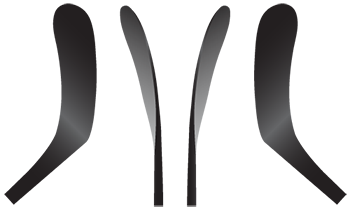
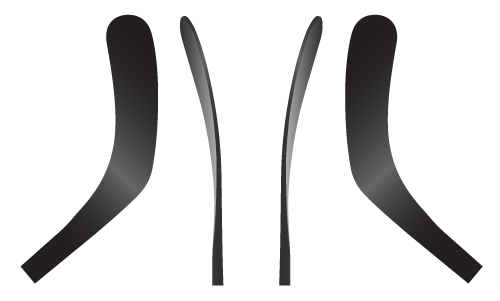
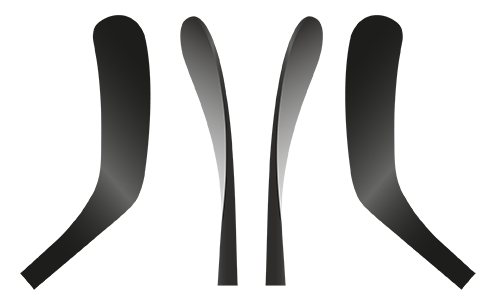
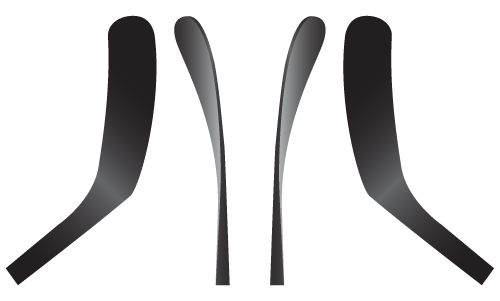
Don’t know where to start? Or searching for a specific curve? Our hockey stick guide will help you through the customization process to be sure you choose the right fit.
Hockey stick curve chart
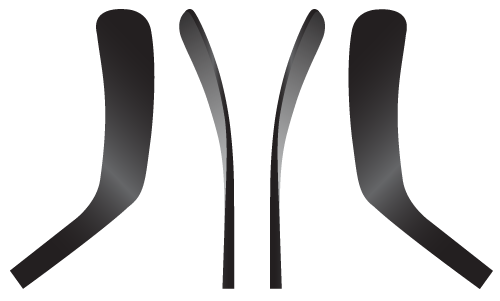
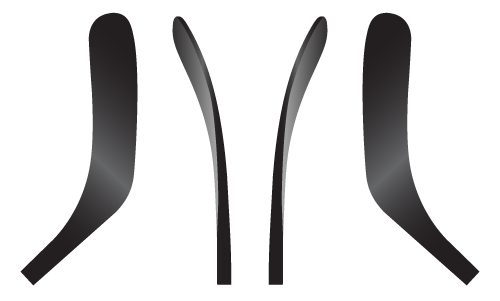
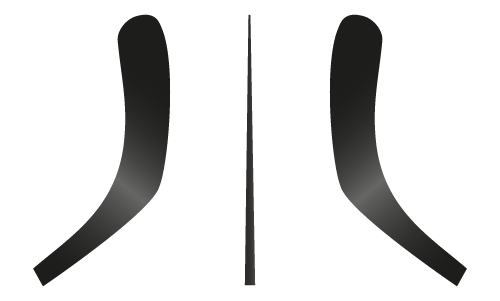
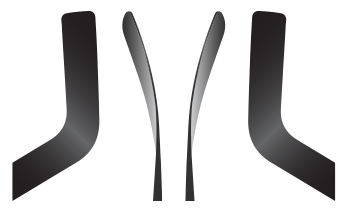
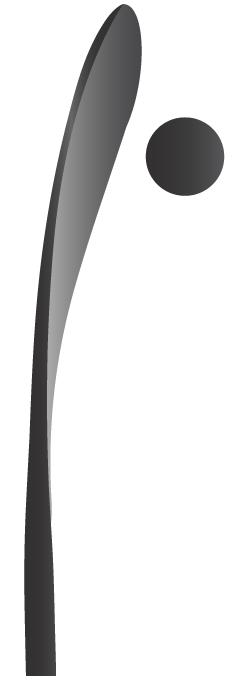
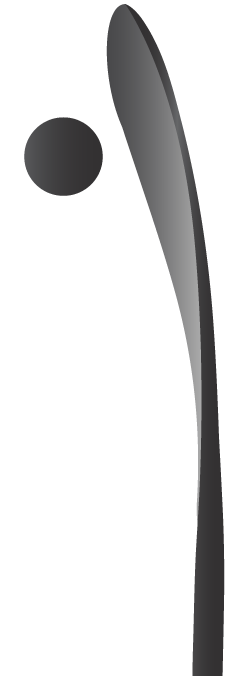
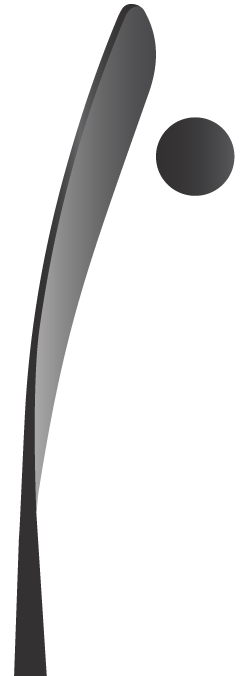
Compare popular brand patterns to CHS equivalent curves and find the setup that matches your shooting style, puck control, and overall feel.
CHS28 / CHS28M
Best For
Quick-release shooters, puck control, toe drags, and offensive creativity.
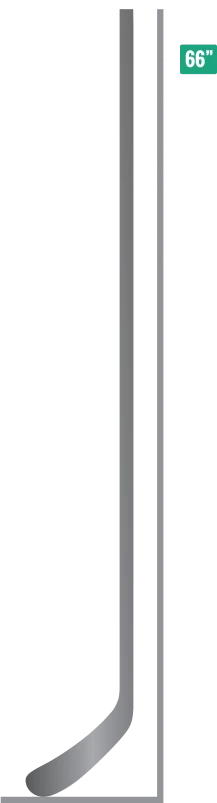
Place your hockey stick upright against a wall with the back of the shaft flat against the surface.
At CHS, stick height is measured from the floor to the very top of the shaft to give you the true overall stick height.
Please note that some brands only measure shaft length or measure to the heel of the blade, which can create misleading size comparisons between brands.
How to measure your hockey stick height
The right stick height can improve:
Puck control
Shooting accuracy
Balance
Passing
Overall comfort
As a general guideline, while standing without skates, the top of your stick should sit between your chin and nose.
Another common method:
Ice hockey: player height minus approximately 6–8 inches
Ball hockey / street hockey: player height minus approximately 9–11 inches
Ultimately, stick height comes down to personal preference and playing style.
Shaft size for each player category
Senior Hockey Sticks
92mm shaft circumference Approx. 3.6″
Intermediate Hockey Sticks
92mm shaft circumference Approx. 3.6″
Junior Hockey Sticks
88mm shaft circumference Approx. 3.46″
Junior blades are slightly smaller than senior blades and may vary depending on curve pattern.
Hockey Stick Flex guide
Stick flex determines how much your stick bends and loads energy during shooting.
Lower Flex
Easier to load
Quicker release
More whip and feel
Higher Flex
Stiffer feel
More stability
Greater control on harder shots
IMPORTANT
Cutting your stick changes the flex. As a general rule, flex increases by approximately 5 points for every inch cut from the top of the shaft. Example: An 85 flex stick cut down by 1 inch will feel closer to a 90 flex.
Bonus Tip
Don’t be afraid to experiment with different flex profiles.
Many players use sticks that are too stiff for their shooting style. Dropping flex can often improve shot release, puck feel, and overall performance.
Sometimes a small flex adjustment can completely change how a stick feels on the ice.
Hockey Stick Kick Point Guide
Kick point determines where your stick flexes and loads energy during your shot. Different kick points change the feel, release speed, and shooting style of your stick.
CHS offers four different kick point options: Low Kick, Hybrid Kick, Mid Kick, and High Kick.
Low Kick
Designed for quick-release shooters.
Low Kick loads energy lower in the shaft, helping players release snapshots and wrist shots faster with less effort.
Best For
Quick-release shooters Offensive forwards Snap shots Fast puck movement Close-range scoring
Hybrid Kick
The best balance between quick release and shot power.
Hybrid Kick combines elements of both low and mid kick profiles, giving players versatility across different shooting styles.
Best For
All-around players Mixed shooting styles Wrist shots and slap shots Players looking for versatility
Mid Kick
Built for powerful, controlled shooting.
Mid Kick loads energy higher through the middle of the shaft, creating stronger energy transfer for heavier shots.
Best For
Powerful shooters Slap shots One-timers Players who lean into their shots
High Kick
Maximum power and stiffness.
High Kick places the flex point higher in the shaft, ideal for players who prefer a stiffer feel and big wind-up shots.
Best For
Strong players Heavy slap shots Traditional shooting feel Maximum shot power
Which kick point is right for me?
There’s no single “best” kick point — it comes down to personal preference, shooting mechanics, and playing style.
Today’s game has increasingly shifted toward lower kick and hybrid kick sticks due to their quicker release and easier shot loading, especially among offensive players.
However, many players still prefer the added stability and power of mid or high kick setups depending on their role and shot style.
Hockey stick lie chart
Stick lie affects how your blade sits on the ice during skating, shooting, passing, and puck handling.
The correct lie helps keep the full bottom of your blade in contact with the ice, improving puck control, comfort, and overall feel.
LIE 5
Typically preferred by players who:
Use longer sticks
Skate lower
Handle the puck farther away from their body
Lie 5 tends to feel more natural for players with a deeper skating posture.
LIE 6
Typically preferred by players who:
Use shorter sticks
Skate more upright
Keep the puck closer to their body
Lie 6 often provides a more upright feel and quicker blade positioning.
How to tell if your lie is correct
Too flat
If the toe of your blade lifts off the ice, your lie may be too low.
This usually happens when:
Your stick is too short
You skate more upright
The puck stays closer to your body
Correct
The full bottom of the blade sits evenly on the ice.
This gives you:
Better puck control
Cleaner passing
Improved shooting feel
More balanced stick handling
Too upright
If the heel of your blade lifts off the ice, your lie may be too high.
This usually happens when:
Your stick is too long
You lean forward more aggressively
The puck stays farther away from your body
IMPORTANT
Each curve pattern is designed with a specific lie profile. Because of this, not all curves are available in multiple lie options. Please consult the CHS Curve Guide for detailed lie information on each pattern.
Hockey Stick Carbon Fiber grades
Carbon fiber plays a major role in the overall feel, balance, durability, and performance of your hockey stick.
Different carbon fiber grades affect: weight, responsiveness, durability, and overall stick feel
At CHS, we offer multiple carbon fiber options to match different player preferences and performance needs.
What is the checkered pattern on the hockey stick?
The checkered pattern comes from woven carbon fiber strands layered together during production.
The “K” refers to the number of carbon fiber filaments woven together. For example:
12K = 12,000 filaments
18K = 18,000 filaments
24K = 24,000 filaments
Generally speaking, higher filament counts increase durability and structural strength.
Which carbon fiber should I choose?
The lighter the hockey stick, the more important carbon fiber quality becomes in maintaining durability and performance.
General Recommendations:
Standard-weight sticks: UD or 12K
Lightweight sticks: 18K or 24K
Maximum durability: 24K
At the end of the day, the best option depends on your playing style, preferred stick weight, and personal feel.
Types of Carbon Fiber
UD - BLACK
Unidirectional carbon fibers run in a single direction rather than a woven pattern, creating a clean all-black finish.
Best For
Traditional feel Solid durability Clean cosmetic finish Players looking for great value
12K
12K carbon fiber uses a tighter woven carbon pattern with 12,000 filaments.
Best For
Balanced durability Lightweight performance Everyday competitive play
18K
18K carbon fiber increases the woven filament count, creating a larger carbon weave pattern with added strength and durability.
Exclusive to the Hyperion series, 24K Sapphire combines our premium 24K carbon fiber with a specialized sapphire coating for additional durability and wear resistance.
Best For
Premium performance builds Players looking for maximum durability Enhanced cosmetic finish and protection
18K/24K Silver
Exclusive to the White Hyperion & Helios series, Silver Carbon combines high-performance carbon fiber construction with a raw forged carbon aesthetic, creating a distinctive silver finish with added durability and wear resistance.
Best For
Premium performance builds Players looking for maximum durability Enhanced cosmetic finish and protection
Hockey Stick Blade Texture
Blade texture affects how the puck feels on your stick during shooting, passing, and puck handling.
Different finishes change the level of grip, release feel, and overall puck control depending on player preference and playing style.
At CHS, we offer three blade finish options:
NONE
Smooth Finish
A clean carbon finish with no added blade texture.
Provides a traditional puck feel with: smooth release, minimal drag, and natural puck movement
Best for
Players who prefer a clean blade feel Quick-release shooters Traditional ice hockey feel
TEXTURED
GRIP FINISH
A subtle textured surface designed to increase puck feel and control while maintaining a clean shooting release.
The texture helps simulate the feel of a lightly taped blade.
Best for
Balanced puck feel Enhanced control Players wanting added grip without excessive drag
Grit
SANDPAPER FINISH
Grip-style coating designed for maximum puck control and stick feel.
Creates additional surface grip between the puck and blade for players who want extra control during handling and shooting.
Best for
Dek hockey players Maximum puck grip Enhanced stick handling feel Players who prefer a tackier blade surface
NOT SURE WHICH SIDE YOU ARE?
The best way to determine your player side is simple:
Hold a stick naturally
Take a few shots
Handle a puck
See what feels most comfortable and balanced
Your natural shooting side should feel instinctive and controlled.
Hockey Stick Weight Guide
Stick weight affects how your stick feels during shooting, puck handling, passing, and overall play.
Lighter sticks can improve release speed and handling, while slightly heavier constructions may provide added durability and stability.
At CHS, we offer multiple weight options so players can choose the balance of performance, feel, and durability that fits their game.
Carbon-Mixed
470 ±15G
Our most durable standard-weight construction.
Best For
Durability Reliability Long-term performance Overall value
Normal
420 ±15G
A balanced everyday performance option with a strong mix of durability, feel, and responsiveness.
Best For
Most players Balanced performance Everyday competitive hockey Players looking for all-around feel
LIGHTWEIGHT
375 ±15G
Reduced swing weight for quicker handling and faster release while maintaining strong overall durability.
Best For
Faster puck movement Offensive players Quick-release shooting Players wanting a lighter feel
ULTRALIGHT
350 ±15G
Built for players looking for elite-level responsiveness, quick hands, and the lightest possible feel.
Best For
High-level players Fast-paced offensive play Elite puck handling Maximum responsiveness
IMPORTANT
Lighter sticks improve handling and release speed, but may sacrifice some durability compared to heavier constructions. The best weight ultimately comes down to your playing level, preferences, and how you want the stick to feel on the ice.
Hockey Stick Player Side
Choosing the correct player side comes down to what feels most natural for your puck control, shooting, and overall comfort on the ice.
For most players, the top hand controls the stick, while the lower hand provides power and support.
Player Left
If your right hand sits at the top of the stick and your left hand is lower on the shaft, you are a left-handed shooter.
Common Feel
Strong puck control with the right/top hand
Natural for players who feel more comfortable controlling the stick with their dominant right hand
Player Right
If your left hand sits at the top of the stick and your right hand is lower on the shaft, you are a right-handed shooter.
Common Feel
Strong puck control with the left/top hand
Natural for players who feel more comfortable controlling the stick with their dominant left hand
Goalie Left
If you hold the stick with your right-hand blocker and catch with your left glove hand, you are a left-catching goalie.
This is the most common goalie setup.
Goalie Right
If you hold the stick with your left-hand blocker and catch with your right glove hand, you are a right-catching goalie.
This setup is sometimes referred to as “full right.”
NOT SURE WHICH SIDE YOU ARE?
The best way to determine your player side is simple:
Hold a stick naturally
Take a few shots
Handle a puck
See what feels most comfortable and balanced
Your natural shooting side should feel instinctive and controlled.